

Business

How should group practice owners pay themselves a salary?

For many group practice owners, one of the most confusing financial questions is deceptively simple: how do I actually pay myself?

Melissa Bhatia
Melissa Bhatia
Published on May 22, 2026
Updated on May 22, 2026

You built a practice. You hired clinicians, navigated insurance credentialing, and built clinical workflows – but your own paycheck became an afterthought. You pull from the business account when needed, hope there's enough left at the end of the month, and tell yourself you'll "figure out the salary thing" later.Β 

Running a group practice is demanding work, and your compensation should reflect that. How you pay yourself is a core business decision β€” one that deserves the same intentionality as any other. Here's how to approach it.

Why most practice owners underpay themselves"

Most practice owners start as sole proprietors β€” and many stay that way for years. As a sole proprietor, there's no legal separation between you and your business. The money the business makes is your money. You don't technically pay yourself a "salary" β€” you take owner's draws, which is simply moving money from the business account to your personal account.

This works, but it has a serious flaw: without a structured approach, most owners underpay themselves, overspend in the business, and can end up with cash flow confusion that makes it hard to plan, grow, or evaluate whether the practice is truly profitable.

Without clarity on what you should be taking home, compensation becomes reactive β€” you take what's there when you need it, rather than building a business that consistently supports your livelihood. That's not sustainable, and it's not a strategy. Frameworks like Profit First exist precisely to solve this problem.

The Profit First approach for practice owners

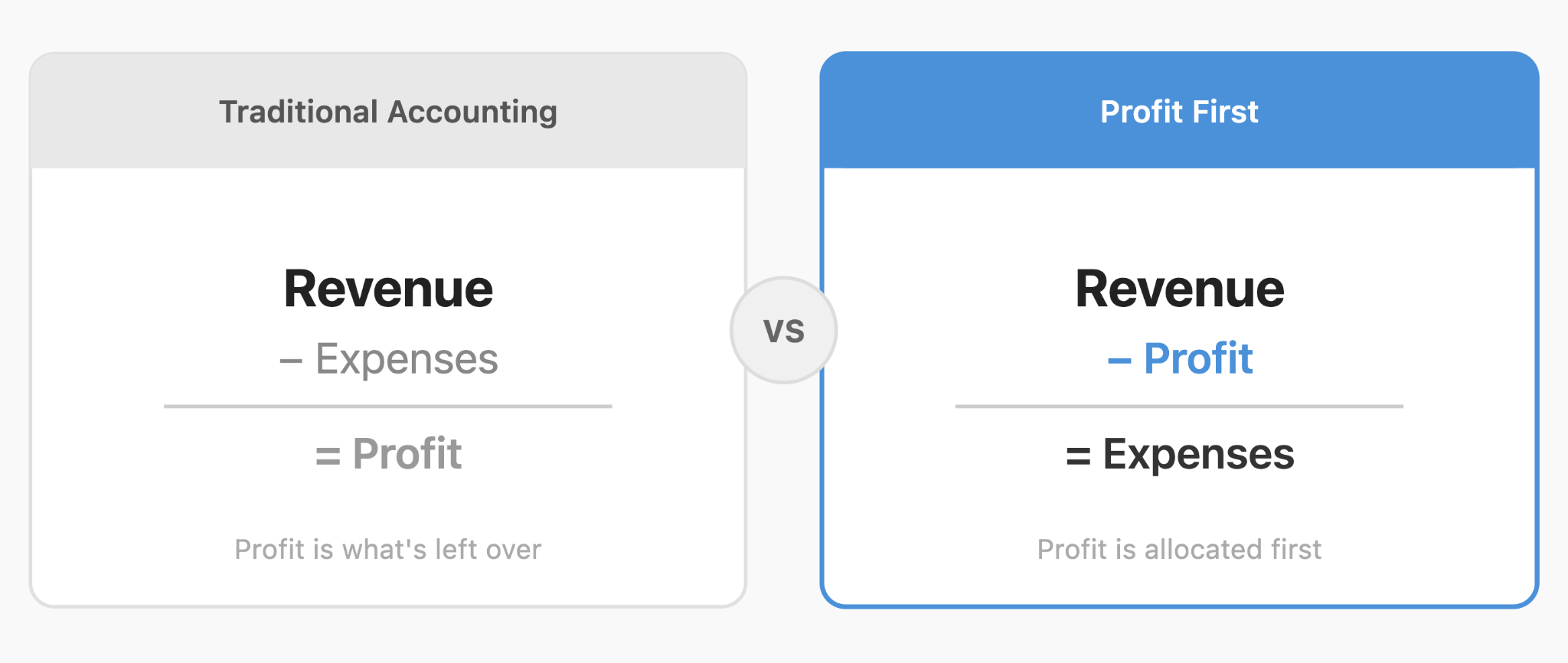
The Profit First methodology, developed by Mike Michalowicz, flips the traditional business accounting formula on its head. Instead of:
‍

‍

In practice, this means every time money comes into your business, you immediately allocate a percentage to separate accounts: profit, owner's pay, taxes, and operating expenses β€” before you pay anything else.

For practice owners, this framework is particularly powerful because it creates discipline around a question that otherwise gets deferred indefinitely: what percentage of revenue should I be paying myself?

A rough starting target for a solo or small group practice is 50% of revenue to owner's compensation (including your pay and any profit distributions). If you're running a larger group with multiple employees, that number will be lower β€” but the principle holds. Decide the percentage and fund it first. Then run your operations on what's left.

This approach also forces you to confront a harder truth: if your margins don't support a livable owner's salary, the business model itself needs to change.Β 

Sole Proprietor vs. S-Corp: which pay structure is right for you?

Once a practice reaches a certain revenue threshold, the S-Corporation structure often comes up in conversations with CPAs as a potential tax savings strategy. Here's what you actually need to know.

As a sole proprietor, all of your net business income is subject to self-employment tax β€” currently 15.3% on the first $168,600 of net earnings. You take owner's draws rather than a salary, and there's no payroll involved. Simple, low-overhead, and perfectly appropriate for many practices.

An S-Corp changes the structure. You become an employee of your own business, pay yourself a reasonable W-2 salary, and take any remaining profit as a shareholder distribution β€” which is not subject to self-employment tax. That's the tax savings everyone talks about.

But S-Corps come with real costs: payroll software, additional tax filings, and higher CPA fees. These typically run $2,000–$7,000+ per year depending on your income level and state. That means the savings only make sense once your net profit is high enough to justify the overhead β€” generally somewhere in the $150,000–$350,000 range, which is also the sweet spot before Social Security tax savings start to plateau.

Use the calculator below to run your own numbers:

Sole Prop vs. S-Corp Calculator | Healthie

Sole Prop vs. S-Corp: Which Makes Sense for You?

Approximate figures for illustration only β€” consult a CPA for your situation

$
Annual profit after business expenses
40% 75%
IRS requires a "reasonable" salary β€” typically 50–65%
$
β†Ί Reset to estimate
Sole Proprietor
Gross Net Incomeβ€”
Self-Employment Taxβ€”
Federal Income Tax (est.)β€”
S-Corp Admin Costsβ€”
Est. Take-Homeβ€”
S-Corp
Gross Net Incomeβ€”
Payroll Tax on Salaryβ€”
Federal Income Tax (est.)β€”
S-Corp Admin Costsβ€”
Est. Take-Homeβ€”
πŸ“Œ Why does S-Corp save less at higher incomes? Social Security tax (12.4%) caps at $168,600 in wages. Once your S-Corp salary exceeds that threshold, you lose the SS savings and only save Medicare tax (2.9%) on your distribution. The S-Corp sweet spot is typically net income between $150K–$350K.

Estimates use simplified 2024 federal tax brackets. SS wage base: $168,600. State taxes, deductions, and other factors will affect your actual numbers. Always consult a licensed CPA.

The bottom line: don't switch to an S-Corp because it sounds like a smart move. Switch because the numbers β€” your numbers β€” confirm it's worth it.

What actually determines how much you can pay yourself

Your pay structure (sole proprietor vs. S-Corp) affects how you take money out β€” but it doesn't change what's actually available to pay yourself. That comes down to your practice's real profitability.

A few levers that have an outsized impact on owner compensation in group practices:

Payer mix matters enormouslyΒ 

Private pay practices generate significantly more margin per session than insurance-based ones. If more than half your revenue comes through insurance panels, you're working with thinner margins, and your path to a strong owner salary depends on volume, efficiency, and keeping overhead lean.

How you pay your clinicians has a compounding effect

Flat-rate pay (a set dollar amount per session) is generally more predictable and easier to model than percentage-based pay. Percentage splits can feel fair, but as your revenue grows, your labor costs grow proportionally β€” making it harder to widen your margins no matter how many clients you add.

Growth doesn't automatically mean more profit

Adding clinicians means adding costs β€” supervision, admin support, software seats. If you expand before you've stress-tested your margins, you can end up with a bigger practice that actually pays you less than you made when you were solo.Β 

A simple starting framework

If you're not sure where to begin, here's a practical starting point:

  1. Know your numbers. What is your practice's actual monthly net income after all expenses?
  2. Set a salary target first. What do you need to live on? What would you be paid if you worked for someone else in your role?
  3. Allocate that salary as a non-negotiable business expense. Use the Profit First model to make owner pay a fixed percentage, not whatever is left over.
  4. Then ask whether your structure supports that number. If it doesn't, then that is your core problem to address (not changing your business entity).Β 
  5. Consult a CPA who works with healthcare practices. The specifics of your state, entity type, revenue level, and growth stage all matter. General advice is helpful has limits.

Running a profitable practice takes more than clinical excellence

The clinicians who thrive financially over the long run aren't just good clinicians β€” they treat their practice like a business. That means tracking revenue, understanding their margins, paying themselves intentionally, and making structure decisions based on data rather.Β 

That kind of clarity doesn't happen by accident. It comes from having the right systems in place that give you visibility into how your practice is actually performing, so you spend less time managing chaos and more time making decisions that move your business forward.

If you're a solo provider or group practice and want a platform designed to support that growth, learn more about how Healthie can help.

‍

This post is for educational purposes only and does not constitute legal, financial, or tax advice. Please consult a licensed CPA or financial advisor for guidance specific to your situation.

‍

Launch, grow & scale your business today.

Business

How should group practice owners pay themselves a salary?

For many group practice owners, one of the most confusing financial questions is deceptively simple: how do I actually pay myself?

You built a practice. You hired clinicians, navigated insurance credentialing, and built clinical workflows – but your own paycheck became an afterthought. You pull from the business account when needed, hope there's enough left at the end of the month, and tell yourself you'll "figure out the salary thing" later.Β 

Running a group practice is demanding work, and your compensation should reflect that. How you pay yourself is a core business decision β€” one that deserves the same intentionality as any other. Here's how to approach it.

Why most practice owners underpay themselves"

Most practice owners start as sole proprietors β€” and many stay that way for years. As a sole proprietor, there's no legal separation between you and your business. The money the business makes is your money. You don't technically pay yourself a "salary" β€” you take owner's draws, which is simply moving money from the business account to your personal account.

This works, but it has a serious flaw: without a structured approach, most owners underpay themselves, overspend in the business, and can end up with cash flow confusion that makes it hard to plan, grow, or evaluate whether the practice is truly profitable.

Without clarity on what you should be taking home, compensation becomes reactive β€” you take what's there when you need it, rather than building a business that consistently supports your livelihood. That's not sustainable, and it's not a strategy. Frameworks like Profit First exist precisely to solve this problem.

The Profit First approach for practice owners

The Profit First methodology, developed by Mike Michalowicz, flips the traditional business accounting formula on its head. Instead of:

‍

‍

In practice, this means every time money comes into your business, you immediately allocate a percentage to separate accounts: profit, owner's pay, taxes, and operating expenses β€” before you pay anything else.

For practice owners, this framework is particularly powerful because it creates discipline around a question that otherwise gets deferred indefinitely: what percentage of revenue should I be paying myself?

A rough starting target for a solo or small group practice is 50% of revenue to owner's compensation (including your pay and any profit distributions). If you're running a larger group with multiple employees, that number will be lower β€” but the principle holds. Decide the percentage and fund it first. Then run your operations on what's left.

This approach also forces you to confront a harder truth: if your margins don't support a livable owner's salary, the business model itself needs to change.Β 

Sole Proprietor vs. S-Corp: which pay structure is right for you?

Once a practice reaches a certain revenue threshold, the S-Corporation structure often comes up in conversations with CPAs as a potential tax savings strategy. Here's what you actually need to know.

As a sole proprietor, all of your net business income is subject to self-employment tax β€” currently 15.3% on the first $168,600 of net earnings. You take owner's draws rather than a salary, and there's no payroll involved. Simple, low-overhead, and perfectly appropriate for many practices.

An S-Corp changes the structure. You become an employee of your own business, pay yourself a reasonable W-2 salary, and take any remaining profit as a shareholder distribution β€” which is not subject to self-employment tax. That's the tax savings everyone talks about.

But S-Corps come with real costs: payroll software, additional tax filings, and higher CPA fees. These typically run $2,000–$7,000+ per year depending on your income level and state. That means the savings only make sense once your net profit is high enough to justify the overhead β€” generally somewhere in the $150,000–$350,000 range, which is also the sweet spot before Social Security tax savings start to plateau.

Use the calculator below to run your own numbers:

Sole Prop vs. S-Corp Calculator | Healthie

Sole Prop vs. S-Corp: Which Makes Sense for You?

Approximate figures for illustration only β€” consult a CPA for your situation

$
Annual profit after business expenses
40% 75%
IRS requires a "reasonable" salary β€” typically 50–65%
$
β†Ί Reset to estimate
Sole Proprietor
Gross Net Incomeβ€”
Self-Employment Taxβ€”
Federal Income Tax (est.)β€”
S-Corp Admin Costsβ€”
Est. Take-Homeβ€”
S-Corp
Gross Net Incomeβ€”
Payroll Tax on Salaryβ€”
Federal Income Tax (est.)β€”
S-Corp Admin Costsβ€”
Est. Take-Homeβ€”
πŸ“Œ Why does S-Corp save less at higher incomes? Social Security tax (12.4%) caps at $168,600 in wages. Once your S-Corp salary exceeds that threshold, you lose the SS savings and only save Medicare tax (2.9%) on your distribution. The S-Corp sweet spot is typically net income between $150K–$350K.

Estimates use simplified 2024 federal tax brackets. SS wage base: $168,600. State taxes, deductions, and other factors will affect your actual numbers. Always consult a licensed CPA.

The bottom line: don't switch to an S-Corp because it sounds like a smart move. Switch because the numbers β€” your numbers β€” confirm it's worth it.

What actually determines how much you can pay yourself

Your pay structure (sole proprietor vs. S-Corp) affects how you take money out β€” but it doesn't change what's actually available to pay yourself. That comes down to your practice's real profitability.

A few levers that have an outsized impact on owner compensation in group practices:

Payer mix matters enormouslyΒ 

Private pay practices generate significantly more margin per session than insurance-based ones. If more than half your revenue comes through insurance panels, you're working with thinner margins, and your path to a strong owner salary depends on volume, efficiency, and keeping overhead lean.

How you pay your clinicians has a compounding effect

Flat-rate pay (a set dollar amount per session) is generally more predictable and easier to model than percentage-based pay. Percentage splits can feel fair, but as your revenue grows, your labor costs grow proportionally β€” making it harder to widen your margins no matter how many clients you add.

Growth doesn't automatically mean more profit

Adding clinicians means adding costs β€” supervision, admin support, software seats. If you expand before you've stress-tested your margins, you can end up with a bigger practice that actually pays you less than you made when you were solo.Β 

A simple starting framework

If you're not sure where to begin, here's a practical starting point:

  1. Know your numbers. What is your practice's actual monthly net income after all expenses?
  2. Set a salary target first. What do you need to live on? What would you be paid if you worked for someone else in your role?
  3. Allocate that salary as a non-negotiable business expense. Use the Profit First model to make owner pay a fixed percentage, not whatever is left over.
  4. Then ask whether your structure supports that number. If it doesn't, then that is your core problem to address (not changing your business entity).Β 
  5. Consult a CPA who works with healthcare practices. The specifics of your state, entity type, revenue level, and growth stage all matter. General advice is helpful has limits.

Running a profitable practice takes more than clinical excellence

The clinicians who thrive financially over the long run aren't just good clinicians β€” they treat their practice like a business. That means tracking revenue, understanding their margins, paying themselves intentionally, and making structure decisions based on data rather.Β 

That kind of clarity doesn't happen by accident. It comes from having the right systems in place that give you visibility into how your practice is actually performing, so you spend less time managing chaos and more time making decisions that move your business forward.

If you're a solo provider or group practice and want a platform designed to support that growth, learn more about how Healthie can help.

‍

This post is for educational purposes only and does not constitute legal, financial, or tax advice. Please consult a licensed CPA or financial advisor for guidance specific to your situation.

‍

Scale your care delivery with Healthie+.