



From session to chart in minutes: the case for automated therapy notes
AI-powered session notes are reducing charting time by up to 80% in behavioral health practices. Use our calculator to see how AI could impact your practice.

Documentation burden is one of the top drivers of clinician burnout in behavioral health. AI-powered session notes are changing that, and early-adopting practices are becoming helpful case studies for other practice owners and operators.
The problem: notes are eating your clinicians' time
Clinicians train for years to treat patients, but too often become burnt out by spending their evenings charting. This has been happening across behavioral health practices of all sizes. Clinicians spend roughly 35% of their working time on administrative tasks, and approximately 16 minutes per patient encounter on documentation alone. Multiply that across a full caseload and it is a meaningful portion of every clinician's week that is consistently spilling past business hours.
For practice owners, this has a direct operational cost. After-hours charting is the strongest predictor of burnout, and burned-out clinicians leave. Industry estimates put therapist replacement costs at $50,000 to $80,000 per position once recruiting, credentialing, lost revenue, and ramp-up time are factored in. At that rate, a documentation problem is quietly an expensive retention problem as well.
AI as a solution
The technology has finally caught up to the problem. AI session note automation listens to the clinical encounter in real time and generates a structured draft note in the clinician's chosen format within minutes of the session ending. The clinician reviews, edits as needed, and signs, with the ability to complete charting before the next patient arrives.
The shift is specific: clinicians move from authoring notes from memory and shorthand to editing an accurate draft. That is a meaningfully different cognitive task, and a much lighter one. What changes at the practice level:
- After-hours charting drops significantly or disappears for most clinicians
- Note quality standardizes across your team regardless of clinician style or experience level
- New patient capacity opens without adding headcount
- Billing documentation is more complete, reducing denials and strengthening medical necessity
- Same-day note delivery to referring physicians becomes operationally feasible
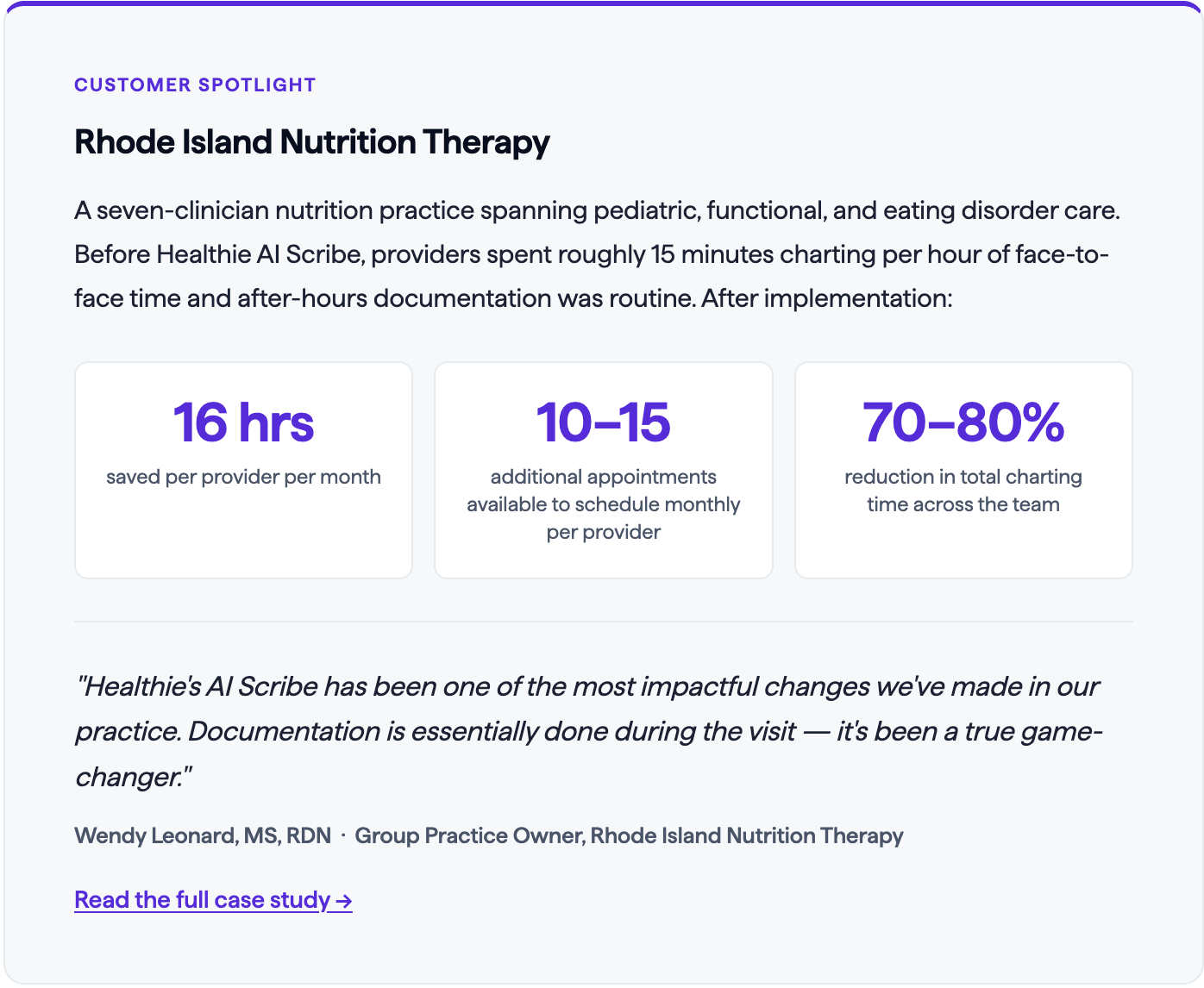
Rhode Island Nutrition Therapy, a seven-clinician group practice and early Healthie AI Scribe adopter, experienced all of this firsthand.
Calculate your practice's time and revenue opportunity
Every practice is different, with varying caseload sizes, session rates, and how much time clinicians spend charting. Use the calculator below to run your own estimate on capacity.
Beyond the capacity gains the calculator surfaces, two other areas compound the business case.
- Clinician retention: Pajama time, or clinical work completed after hours, is the strongest documented predictor of burnout in behavioral health. When it becomes habitual, clinicians begin evaluating exits within 12 to 18 months. Cutting even 30 minutes of daily documentation is one of the most direct retention levers available. The JAMA Network Open study cited above found a nearly 14 percentage point drop in burnout among clinicians who adopted AI scribes, in 30 days.
- Referral relationship strength: Consistent, timely documentation is also a business development asset. Rhode Island Nutrition Therapy built a same-day SOAP note fax protocol for referring physicians once AI Scribe made consistent note delivery operationally feasible. Referring physicians received exactly what they needed, and a referral relationship that drives new patient volume was strengthened in the process.This can be a differentiating factor for your practice that makes referring physicians more likely to refer your practice again.
What to look for when evaluating session note automation
Choosing the right tool matters as much as choosing to adopt one. These are the features that separate implementations that stick from ones that add friction:
- Native EHR integration. Tools that require copy-pasting between systems or managing a separate login introduce the kind of workflow friction that kills adoption. The strongest implementations generate the draft note directly in the chart, tied to the appointment, using the clinician's existing template.
- Template awareness. A note for an initial intake looks different from a follow-up. A pediatric nutrition visit captures different data than a functional medicine consult. Effective automation ties specific note templates to specific appointment types so the draft that appears is already structured for the work that was done.
- Human-in-the-loop by design. Notes should arrive as drafts, not auto-signed documents. Every implementation should require clinician review before a note enters the official chart. This is the appropriate clinical safeguard, and it is where clinicians spend their remaining minutes ensuring the note reflects what actually occurred.
- HIPAA-compliant infrastructure. Audio capture and transcription must remain within a closed, HIPAA-compliant environment. No session content should leave the platform or be used to train underlying models.
- Consent integration. Patient consent to recording should be built into intake forms and reviewed at the first session, with a clear opt-out. Rhode Island Nutrition Therapy's experience: most patients accept it readily when it is presented as a routine part of the intake process.
Final thoughts
As AI adoption grows across behavioral health, practice owners have the opportunity to understand how their peers are leveraging AI in their practices. Looking at the results others are experiencing and applying those numbers to your own practice turns what once felt abstract into something concrete and comparable. Estimating the impact AI adoption could have on your practice puts you in a position to make a decision grounded in evidence, not just a general sense that things could be better.