



Remote therapeutic monitoring in behavioral health: 2026 guide
2026 CPT updates lowered the time and data thresholds for remote therapeutic monitoring. Here’s what behavioral health organizations need to know to bill RTM.
Last updated: October 22, 2026 | We update this guide as CMS releases new details.
Editor’s note (October 2026): Medicare’s CY 2027 proposals would change how RTM programs are staffed. Comments closed September 14, and a final rule is expected this fall.
A patient leaves a session with a plan: practice the grounding exercise, log the craving when it hits, reach out before a bad night becomes a bad week. Say the plan slips a few days later, but no one knows until the next appointment.
Lasting progress is built in the small moments between sessions. Clinicians know those moments matter. But the time they spend on those moments, reviewing check-ins, spotting a rough week, and reaching out early, has often gone unpaid.
Remote therapeutic monitoring (RTM) is one way to pay for the between-session work, and the 2026 CPT updates make RTM easier to use. Treatment management now starts at 10 minutes a month instead of 20 (CPT 98979). Short-duration device supply codes now start at as few as two days of data instead of 16. For organizations with large behavioral health and substance use panels, where engagement is uneven, the lower thresholds recognize more of what your clinicians already do.
RTM also comes with strict requirements: who can bill, which tools qualify, and a pending Medicare rule that could change how programs are staffed. If your organization runs on Healthie, you already have much of the workflow: intake and consent forms, PHQ-9 and GAD-7 with automatic scoring, telehealth for the required monthly call, and charting. What you still need is an RTM tool that meets the FDA device definition. This guide covers what changed, who can bill, and what to check before you launch.
What is remote therapeutic monitoring?
Remote therapeutic monitoring (RTM) is a set of CPT codes that lets eligible clinicians bill for monitoring how a patient is engaging with and responding to treatment between visits. The data is non-physiological, meaning it isn’t a vital sign or lab value. In behavioral health, that can include mood check-ins, validated symptom measures like the PHQ-9 or GAD-7, completion of CBT exercises and homework, and, in substance use treatment, things like craving or urge logs and recovery-plan adherence. Patients can enter this data themselves.
RTM has three parts:
- Setup and education. A one-time code covers onboarding the patient and teaching them to use the tool.
- Device supply. A code covers the monitoring tool and the data it collects, billed per 30-day period.
- Treatment management. Codes cover the clinician’s time each calendar month reviewing the data and talking with the patient. At least one of the clinician-patient conversations must happen live, by phone or video.
Here’s an illustrative example, not a real patient. A patient in outpatient CBT for anxiety completes daily check-ins and thought records in a qualifying app. Midway through the month, their clinician notices sleep ratings dropping, reviews the trend, and holds a brief video call to adjust the plan before the next session. That review time, that conversation, and the monitoring tool are what RTM is designed to recognize.
RTM is different from remote physiologic monitoring (RPM), which tracks data like blood pressure or glucose. RTM and RPM can’t be billed for the same patient in the same month.
New 2026 RTM CPT codes: 98979, 98986, and the lower thresholds
Before 2026, RTM had two high bars:
- Data: At least 16 days of data in a 30-day period.
- Clinician time: At least 20 minutes in a calendar month.
Fall short of either the data bar or the time bar, and nothing was billable. A patient who checked in on 12 days of a hard month didn’t count. Neither did a clinician who spent 14 focused minutes reviewing their data and calling to check in.
For 2026, CMS and the AMA added four codes that create a lower tier:
- CPT 98979 covers treatment management for 10 to 19 minutes in a calendar month. Months with 20 or more minutes still use the 20-minute code (98980).
- CPT 98984, 98985, and 98986 are device supply codes for 2 to 15 days of data in a 30-day period. They cover respiratory, musculoskeletal, and cognitive behavioral therapy monitoring. 98986 is the CBT version, and the one that matters most in behavioral health.
The one-time setup code, 98975, now also requires at least two days of monitoring.
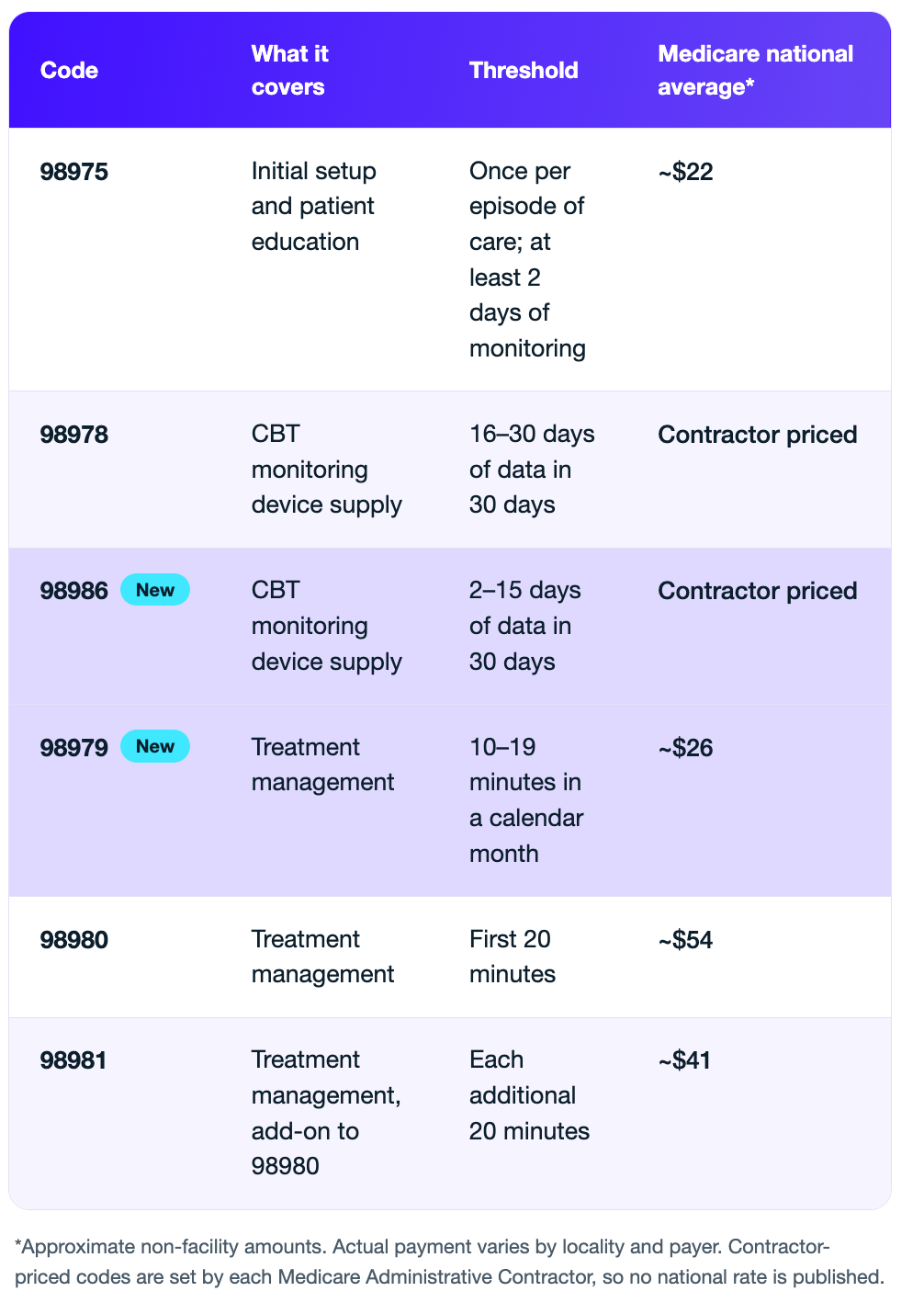
How the codes fit together each month
- One device code per 30 days. Choose either the 2–15 day code or the 16–30 day code, never both. Only one device supply code can be billed per patient per 30 days, no matter how many tools the patient uses.
- One management tier per month. 98979 and 98980 can’t be billed together, and 98981 only attaches to 98980. There is no add-on for 98979.
- Different windows. Device supply is counted per 30-day period, while management is counted per calendar month, so the device supply period and the management month won’t always line up.
Here’s an illustrative example, not a real patient. A patient in an intensive outpatient program checks in on nine days of a 30-day period. Their clinician spends 12 minutes reviewing trends and holds one short video call. Under the old structure, neither threshold was met. Under the 2026 structure, the month can support a short-duration device code, such as 98986 for CBT monitoring, and 98979, provided the documentation, the qualifying tool, and the payer’s coverage are all in place. Had the clinician logged nine minutes instead, 98979 would not apply.
For behavioral health, the lower tier matters because engagement is rarely linear. Patients have weeks where they are more engaged than others, and the 2026 structure pays along that spectrum instead of at a single cliff. Medicare is also proposing changes for 2027 that could affect how RTM programs are staffed, which the 2027 section below covers.
Why RTM matters for behavioral health organizations
For organizations running large behavioral health and substance use panels, RTM offers three practical benefits.
RTM gives clinicians a clearer view between sessions
Patients often struggle to recall how the week went by the time they’re in the room, and a rough Tuesday can fade by Friday. With RTM, structured check-ins give clinicians trend lines, so they can spot a rough patch early, focus the session on what happened, and report outcomes more clearly. For a patient, structured check-ins mean a clinician who already knows about the rough Tuesday and doesn’t depend on the patient to recall how the week went.
RTM recognizes the time clinicians already spend between visits
Unlike per-visit billing, RTM codes are billed monthly, so reviewing data and reaching out between sessions can be reimbursed. At the scale of a multi-site organization, even modest per-patient amounts add up, though the payments have to cover the cost of the monitoring tool and clinician time. Payment varies by payer and locality. For reference, according to the CY 2026 Medicare Physician Fee Schedule, the national average payment for 98979 is about $26 in a non-facility setting. CMS did not set national rates for the CBT device supply codes, 98978 and 98986, so each Medicare Administrative Contractor prices them.
RTM works best with consistent workflows
RTM is a documentation-heavy service, so organizations that already run consistent templates, workflows, and reporting across sites are better positioned to bill RTM cleanly.
Is RTM a fit for your organization?
Likely a good fit. You run CBT-based outpatient care, an intensive outpatient program, or substance use treatment, where patients already complete check-ins and measures between visits. Your billing clinicians are physicians, nurse practitioners, or physician assistants, and Medicare is a meaningful share of your payer mix.
Look closer first. If your monitoring staff are contractors, the 2027 proposal would require the billing practitioner to employ the staff doing the monitoring. If your care team is mostly psychologists, social workers, or counselors, direct billing eligibility is unsettled and varies by payer and state. If most of your patients are commercial or Medicaid, those payers set their own RTM rules.
Be realistic about the money. According to the CY 2026 Medicare Physician Fee Schedule, 98979 pays about $26 a month per patient, and the payment has to cover your RTM tool and clinician time. RTM works better as a pilot than as a new line of business. For a patient, the payoff is a clinician who already knows about the rough week before the next appointment.
What RTM requires
Audits tend to focus on the same few things. Confirm each requirement below before launching a program.
- A qualifying tool. Data must come through a device or software that meets the FDA definition of a medical device. Software can qualify, but generic wellness apps and a standard EHR generally don’t qualify, so most organizations pair their EHR with a purpose-built RTM tool.
- Patient-generated data. The patient enters or transmits the data, not the clinician.
- A live conversation each month. Treatment management codes, including 98979, require at least one real-time phone or video interaction with the patient or caregiver. Texts and secure messages don’t count as the live conversation.
- Documented time. Record the date and minutes spent reviewing data, plus the date and content of each live conversation.
- Documented consent. Record that the patient understands the service and agrees to take part.
- One billing practitioner. Only one practitioner can bill remote monitoring for a patient in a given period, and that practitioner has to be eligible to bill RTM.
Billing guides commonly cite thin time logs, missing consent, and an undocumented live conversation as denial triggers. For a patient, the live conversation is the part that turns a data point into a change in their care.
Who can bill RTM in behavioral health
Under Medicare, physicians, nurse practitioners, physician assistants, and clinical nurse specialists can bill RTM, and so can physical therapists, occupational therapists, and speech-language pathologists under a therapy plan of care. Under those rules, psychiatrists, PMHNPs, and PAs in behavioral health are the clearest fit. Whether psychologists, clinical social workers, and counselors can bill RTM directly is less settled, and it varies by payer and state. Confirm eligibility with your Medicare Administrative Contractor and each payer before building a program around a specific clinician type. For a patient, clinician eligibility decides whether their own clinician can be paid for reviewing their check-ins.
Where your EHR fits
The RTM tool captures the data. Your EHR is where the program runs:
- Enrollment and consent. Standard intake forms and consent documentation across every location.
- Clinical context. Between-session data reviewed alongside notes, treatment plans, and appointments.
- The live conversation. Built-in telehealth and scheduling make the required monthly call easy to hold and document.
- Time and decisions. Charting templates can capture minutes spent, data reviewed, and plan changes, which is what auditors ask for.
- Billing and reporting. Connecting documentation to claims reduces gaps.
- Integrations. Open APIs let you connect a qualifying RTM platform to the rest of the clinical record.
Healthie powers the workflow layer. Pair Healthie with an RTM tool that meets the FDA device definition.
How to launch an RTM program
You don’t have to launch everywhere at once. Starting with one team keeps compliance risk low and gives you real data before you scale.
- Start with a team that’s ready. Pick one service line with strong between-session work, such as CBT-based outpatient care or an intensive outpatient program, and pilot at one or two sites. Clinicians who already value check-ins will tell you what works.
- Check eligibility and coverage. Confirm which clinicians can bill and which payers cover RTM, including CBT device supply.
- Choose a tool patients will actually use. The RTM tool has to meet the FDA device definition and send its data into your clinical record. The tool also has to be simple enough that patients keep checking in.
- Build templates once. Standardize consent, onboarding, time documentation, and monthly review notes, then use them at every site, so clinicians spend their time on patients, not paperwork.
- Train, listen, and track. Teach clinicians the time and live-conversation rules, and ask for their feedback. Then monitor enrollment, engagement, clean claim rate, and outcomes before you expand.
What could change in 2027
Medicare has proposed several changes that would affect how RTM programs run:
- Established patients only. RTM would be furnished only to established patients.
- An initiating visit. A separately reportable visit would have to mark the start of RTM services.
- Employed staff. Payment would be allowed only when the clinical staff are employed by the practice, not contractors. The people doing the monitoring would have to be employed by the billing practitioner.
- Lower valuation and fewer codes. Treatment management codes such as 98979 would lose their practice expense inputs, and CMS is asking whether to consolidate 17 codes into four G-codes.
The 2027 changes above are proposals, not final rules. The comment period closed September 14, 2026. A final rule is expected this fall, with changes generally taking effect January 1, 2027. Organizations that use contracted clinicians or affiliated entities should watch the final rule closely.
Frequently asked questions
Can we bill 98979 and 98980 in the same month?
No. Bill 98979 for 10 to 19 minutes, and 98980 once clinical time reaches 20 minutes.
Can we use our EHR’s forms or portal as the RTM tool?
Generally no. The RTM tool has to meet the FDA definition of a medical device, which a standard EHR typically doesn’t meet. Most organizations pair their EHR with a purpose-built RTM tool.
Can RTM be billed with other services?
RTM and remote physiologic monitoring can’t be billed for the same patient in the same month. RTM can be billed alongside general behavioral health integration when each service’s requirements are met independently and time isn’t counted twice. Collaborative care codes (99492 to 99494) need a separate compliance check. Have your compliance team review any combination.
Support the work that happens between sessions
Your clinicians are already doing the work that keeps patients on track. Healthie gives them the intake and consent forms, PHQ-9 and GAD-7 scoring, telehealth, charting, scheduling, and billing workflows to document the between-session work consistently across every site. Healthie’s GraphQL API, available as an add-on on Enterprise and Group plans, supports webhooks and a sandbox environment for connecting the RTM tool you choose, and the Platform Catalog shows what other organizations have already configured and built.
This article is for informational purposes and is not billing, coding, or legal advice. Coverage and billing rules vary by payer and change over time. Consult your compliance team and payer policies.